
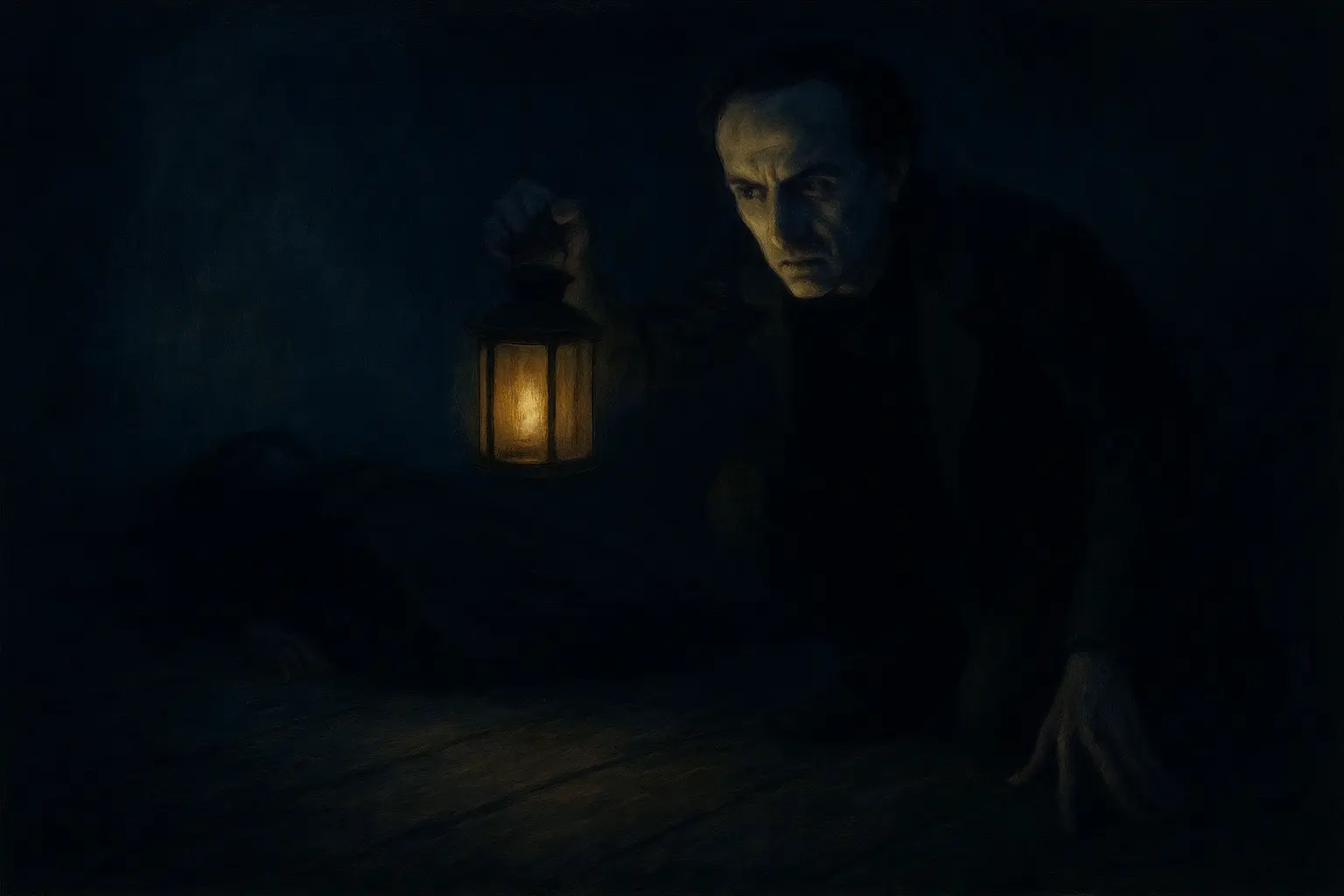
“The Tell-Tale Heart” is Edgar Allan Poe’s most famous short story, and it’s a masterpiece of psychological horror that gets under your skin and stays there. Published in 1843, this brief but intense tale is narrated by a murderer who insists he’s completely sane while describing how he killed an old man because of his disturbing eye. The whole story takes maybe ten minutes to read, but those ten minutes will leave you unsettled.
What makes this story so brilliant is that Poe puts us directly inside the mind of someone having a mental breakdown. There’s no outside narrator to give us perspective or comfort. We only have the murderer’s increasingly frantic voice, trying desperately to convince us (and himself) that he’s rational and in control. The genius of “The Tell-Tale Heart” is how it shows that guilt and paranoia are more powerful than any external punishment. Whether you’re reading it for school or just love psychological thrillers, this story demonstrates why Poe is considered the master of the macabre.
Table of Contents:
Full Story Text
Due to the length of this story, we’ve placed the full text on a separate page of our site. This keeps the article readable while still giving you access to the complete work.
You can view the full story here: The Tell-Tale Heart by Edgar Allan Poe
Summary and Meaning
The story opens with the narrator insisting he’s not mad, which immediately makes us suspect that he absolutely is. He admits he’s going to tell us about a murder, but he wants us to understand that he had a perfectly good reason and that he was completely calm and methodical about the whole thing. His reason? An old man he lived with had a pale blue eye that looked like a vulture’s eye, and it deeply disturbed him.
For seven nights, the narrator sneaks into the old man’s room at midnight, moving so slowly and carefully that it takes him an hour just to get his head through the doorway. He shines a thin beam of light on the old man’s face, but each night the eye is closed, so he doesn’t kill him. The narrator emphasizes that he has nothing against the old man personally. He even claims to love him. It’s just that eye.
On the eighth night, the old man wakes up as the narrator enters. The narrator stays frozen in the doorway for over an hour while the old man sits up in bed, terrified. Finally, the narrator shines his light on the eye, sees it open, and becomes so enraged that he kills the old man. He dismembers the body and hides it beneath the floorboards of the room.
When police arrive after a neighbor reports hearing a shriek, the narrator is supremely confident. He invites them to search thoroughly and even brings chairs into the old man’s room so they can sit and chat. He’s so calm and charming that the police suspect nothing. But then he starts hearing a sound: a low, rhythmic thumping, like a heartbeat. It grows louder and louder until he’s convinced the police must hear it too. Finally, unable to stand it anymore, he confesses everything, tearing up the floorboards to reveal the body.
The deeper meaning? The story is about how guilt destroys us from within. The heartbeat the narrator hears is almost certainly his own, amplified by his guilty conscience and growing paranoia. No amount of careful planning or rational behavior can protect someone from their own psychological collapse. The story also explores how people can convince themselves they’re sane while doing clearly insane things, and how evil acts, no matter how carefully hidden, will eventually reveal themselves.
Themes and Analysis
Guilt and Conscience
The heartbeat is the story’s central symbol and represents the narrator’s guilt. He thinks he’s hearing the dead man’s heart, but it’s really his own guilt manifesting as an auditory hallucination. What’s fascinating is that the guilt doesn’t stop him from committing the murder. He feels perfectly fine while planning and executing it. The guilt only hits him after the deed is done, and when it does, it’s overwhelming and inescapable. Poe shows us that our consciences are more powerful than any external law or punishment.
Madness and Sanity
The narrator’s insistence that he’s sane is what proves he isn’t. He claims his disease has sharpened his senses rather than dulled them, which he sees as evidence of sanity. But the more he tries to prove his rationality by describing his careful, methodical approach to murder, the more unhinged he sounds. This theme asks uncomfortable questions: What is sanity? Can insane people recognize their own madness? The narrator has reasons for everything he does, but they’re the reasons of a madman. Poe brilliantly shows how logic and madness can coexist.
Obsession and Its Destructive Power
The eye becomes an obsession that consumes the narrator completely. He fixates on this one physical detail to the point where it justifies murder in his mind. He doesn’t hate the old man. He’s not robbing him. The eye alone drives him to violence. This speaks to how obsessive thoughts can warp our perception of reality until something meaningless becomes unbearable. The narrator’s obsession is irrational, but to him, it feels utterly reasonable and necessary.
The Impossibility of Hiding Evil
No matter how carefully the narrator plans and executes the murder, no matter how well he hides the body, the truth comes out. The story suggests that evil acts carry their own punishment built in. The narrator literally cannot live with what he’s done. His own mind betrays him, turning his acute hearing (which he was so proud of) into a torture device. Poe is saying that you can’t commit terrible acts and escape the consequences, even if those consequences are entirely psychological.
Time and Perception
The narrator’s perception of time is completely distorted throughout the story. He spends an hour just getting his head through the doorway. He stands frozen for another hour in the darkness. Later, the heartbeat seems to speed up impossibly fast. This distortion reflects his mental state. For him, every moment is stretched or compressed by anxiety, focus, or paranoia. Poe uses this to show how subjective experience differs from objective reality, especially for someone losing their grip on sanity.
Structure and Form
“The Tell-Tale Heart” is a remarkably short story, probably around 2,000 words, but Poe packs incredible psychological depth into that brief space. The entire story is told in first person by the murderer himself, with no framing device or outside perspective. This means we’re trapped in his head for the entire narrative, experiencing his breakdown in real time.
The story is written as a kind of confession, though the narrator isn’t confessing to clear his conscience. He’s trying to prove he’s sane. This creates dramatic irony because everything he says to prove his sanity actually demonstrates his madness. The more he insists he was calm and rational, the more frantic and unhinged his voice becomes.
Poe structures the story in a way that builds tension relentlessly. It starts with the narrator’s declaration of sanity, moves through the seven nights of careful planning, explodes into violence on the eighth night, and then spirals into paranoia during the police visit. The pacing accelerates as the story progresses, mirroring the narrator’s deteriorating mental state. Those short, choppy sentences near the end (“Louder! Louder! Louder!”) create a sense of panic and loss of control.
The use of repetition throughout the story is masterful. The narrator repeats certain words and phrases obsessively: “I heard all things in the heaven and in the earth. I heard many things in hell.” “True! Nervous, very, very dreadfully nervous.” “It grew louder, louder, louder!” This repetition mimics the way anxious or obsessive thoughts loop in our minds, and it creates a hypnotic, unsettling rhythm.
Historical and Literary Context
Edgar Allan Poe published “The Tell-Tale Heart” in 1843 in The Pioneer magazine. By this point in his career, Poe had perfected the psychological horror story. While Gothic fiction had existed for decades, Poe was pioneering something new: horror that came from inside the human mind rather than from external supernatural threats.
The 1840s saw growing interest in mental illness and criminal psychology. People were fascinated by what made criminals tick and whether madness could be distinguished from evil. “The Tell-Tale Heart” taps into these concerns. The narrator might be legally insane, but does that excuse his actions? Can someone be methodical and insane at the same time? These were live questions in Poe’s era.
The story also reflects Romantic literary values, particularly the focus on intense emotion, individual psychological experience, and the dark side of human nature. While many Romantic writers celebrated imagination and passion, Poe explored what happens when those qualities become pathological. The narrator’s heightened sensitivity to sound, which he sees as a gift, becomes his downfall.
Poe was also influenced by Gothic literature’s interest in the macabre and by emerging detective fiction. Interestingly, “The Tell-Tale Heart” works almost like an inverted detective story. Instead of following an investigator solving a crime, we follow the criminal trying to commit the perfect murder and ultimately defeating himself.
The story has autobiographical echoes as well. Poe struggled with mental health issues, poverty, and alcoholism throughout his life. While he certainly never murdered anyone, he understood the experience of feeling like his mind was turning against him. That authentic understanding of psychological distress is part of what makes his horror so effective.
Significance and Impact
“The Tell-Tale Heart” essentially created the template for the unreliable narrator in modern fiction. Countless stories, novels, and films have since used the technique of a narrator whose perception of reality can’t be trusted. From “Fight Club” to “Gone Girl,” the influence is clear. Poe showed that you could make a story more unsettling by making readers question everything the narrator tells them.
The story has had massive cultural impact. It’s been adapted into films, television episodes, plays, and even an opera. Teachers assign it constantly because it’s short enough to read in one sitting but rich enough to analyze for weeks. Phrases from the story, particularly the beating heart as a symbol of guilt, have entered our cultural vocabulary.
From a literary craft perspective, “The Tell-Tale Heart” is a masterclass in first-person narration, building tension, and psychological horror. Poe proves that you don’t need supernatural elements to create terror. The scariest thing in this story is simply a guilty conscience. That insight influenced generations of horror and thriller writers who followed.
The story also remains relevant because it explores timeless aspects of human psychology: guilt, obsession, the fragility of sanity, and the gap between how we see ourselves and how we actually are. These themes resonate just as strongly today as they did in 1843. We’ve all experienced that moment when our own minds seem to work against us, when anxiety amplifies small sounds, when we can’t escape our own thoughts. Poe captures that experience with unnerving accuracy.
Famous Lines and Quotes
“True! Nervous, very, very dreadfully nervous I had been and am; but why will you say that I am mad?” This opening line immediately establishes the narrator’s voice and the story’s central tension. The frantic repetition of “very” and the defensive tone tell us everything about his mental state.
“I heard all things in the heaven and in the earth. I heard many things in hell. How, then, am I mad?” The narrator’s claim that his disease has given him superhuman hearing is one of his key pieces of “evidence” for his sanity. Of course, it proves the opposite.
“It is impossible to say how first the idea entered my brain; but once conceived, it haunted me day and night.” This captures how obsessive thoughts take root and grow until they consume everything. The idea of murdering the old man becomes unavoidable for the narrator.
“I made up my mind to take the life of the old man, and thus rid myself of the eye forever.” The casual, matter-of-fact tone here is chilling. He talks about murder the way someone might talk about fixing a leaky faucet.
“It grew louder, louder, louder!” The escalating repetition at the story’s climax perfectly captures the narrator’s spiraling panic. You can hear his control slipping away with each repeated word.
Conclusion
“The Tell-Tale Heart” by Edgar Allan Poe endures because it captures something fundamental about guilt and the human mind. Poe understood that we can be our own worst enemies, that no external punishment is as terrible as what our own consciences can inflict. The story works as a thriller, as a character study, and as a philosophical exploration of sanity and morality.
What makes it especially powerful is how it forces us into uncomfortable proximity with evil. We spend the entire story inside a murderer’s head, hearing his justifications, experiencing his paranoia. It’s disturbing and fascinating at the same time. We can’t look away even though we probably want to. That’s the mark of great horror: it compels us to confront things we’d rather avoid.
The story’s ending feels both inevitable and surprising. Of course the narrator confesses, we realize in retrospect. He was always going to confess. His guilt was always going to destroy him. But in the moment, as he sits there confidently chatting with the police, we hope maybe he’ll get away with it. When he doesn’t, when he tears up the floorboards himself, it’s both shocking and deeply satisfying. Justice comes not from the law but from within.
Frequently Asked Questions
Is the narrator in The Tell-Tale Heart male or female?
Poe never explicitly states the narrator’s gender, though most readers assume male. This ambiguity is actually interesting because it means the psychology Poe explores is fundamentally human rather than specifically masculine or feminine. Some modern adaptations have cast the narrator as female, which works just as well. The obsession, guilt, and madness aren’t gender-specific.
What does the eye symbolize in the story?
The eye represents whatever the narrator projects onto it. He calls it a “vulture eye” and claims it’s pale blue with a film over it. Some interpretations suggest it represents judgment or conscience, something that sees through the narrator’s facade. Others read it as a manifestation of the narrator’s own mental illness. He fixates on something relatively ordinary and transforms it into something unbearable through his diseased perception.
Is the heartbeat real or imaginary?
The heartbeat is almost certainly imaginary. It’s likely the narrator’s own heartbeat amplified by guilt and anxiety. The police hear nothing unusual, which tells us the sound exists only in the narrator’s mind. This auditory hallucination represents his guilty conscience manifesting in physical form. His acute hearing, which he bragged about earlier, has become a curse.
Why does the narrator confess?
The narrator confesses because he literally cannot stand the psychological torture anymore. The heartbeat (his guilt) becomes so overwhelming that he believes the police must hear it too. He thinks they’re mocking him by pretending not to hear it. Confessing feels like the only way to make the sound stop. His guilt has destroyed him more effectively than any external punishment could.
What is the relationship between the narrator and the old man?
Poe keeps this deliberately vague. The narrator claims to love the old man and says he has no rational motive to kill him. They seem to live together, possibly as caretaker and patient, or perhaps as roommates or family members. The vagueness actually strengthens the story because it emphasizes that the narrator’s motive is purely psychological. The relationship doesn’t matter; only his obsession with the eye matters.
What mental illness does the narrator have?
Poe doesn’t give a clinical diagnosis, and we should be careful about retrospectively diagnosing literary characters. That said, the narrator shows symptoms of several conditions: paranoid psychosis (the auditory hallucinations and persecutory beliefs), obsessive-compulsive disorder (the fixation on the eye), and possibly antisocial personality disorder (the lack of empathy or remorse until after the murder). Whatever his condition, he’s clearly experiencing a severe mental health crisis.
How long is The Tell-Tale Heart?
“The Tell-Tale Heart” is one of Poe’s shortest stories, around 2,000 words or about 5 to 7 pages depending on the edition. It typically takes 10 to 15 minutes to read. This brevity is part of its power. Poe wastes no words, creating maximum psychological impact in minimal space. The short length also mirrors the compressed, intense experience of the narrator’s breakdown.
Explore More Poe
If you enjoyed our analysis, keep exploring Poe’s universe with the following articles:
The Black Cat by Edgar Allan Poe: Analysis and Interpretation
The Cask of Amontillado by Edgar Allan Poe: Analysis and Interpretation