
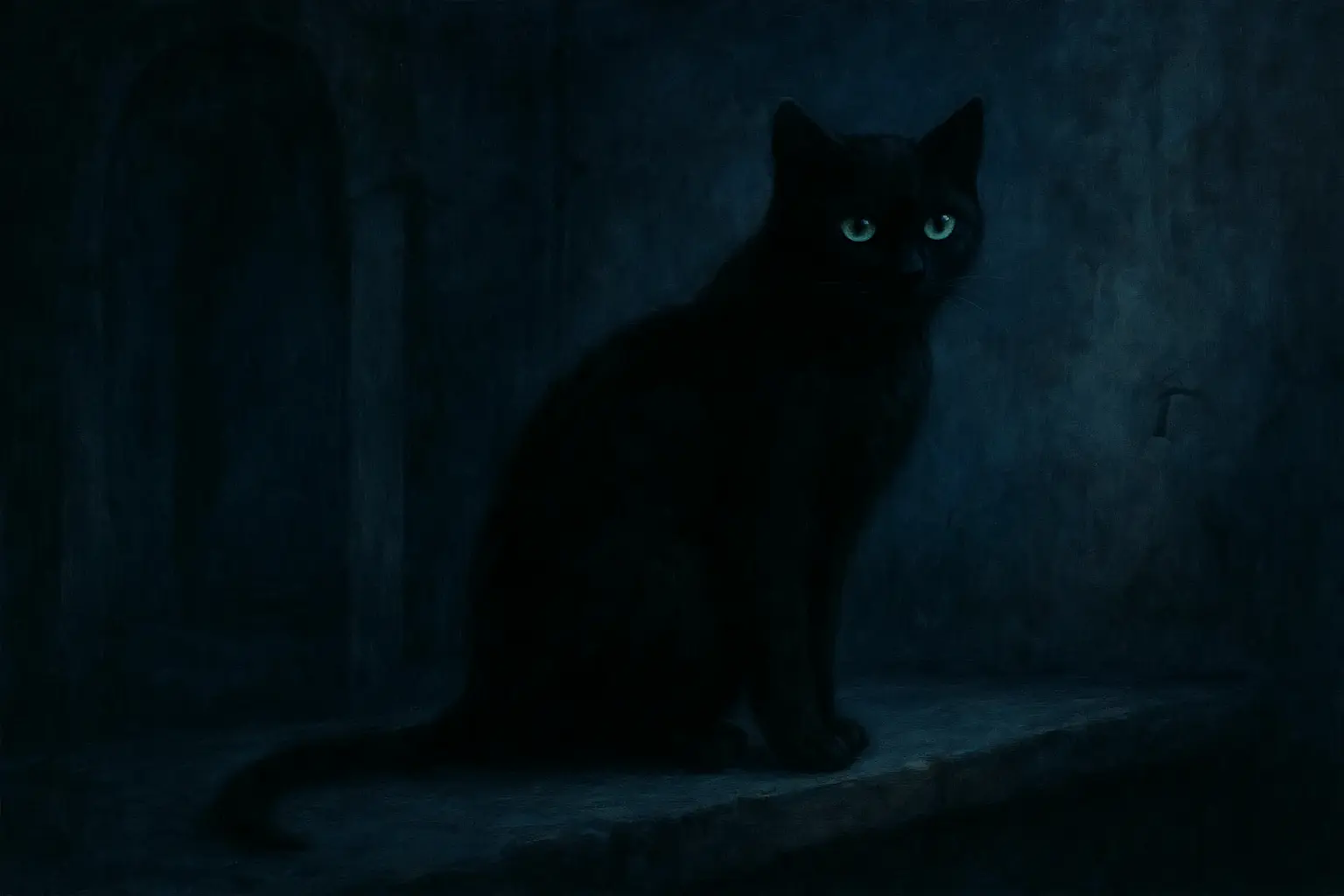
“The Black Cat” is one of Edgar Allan Poe’s most disturbing stories, and that’s saying something considering his body of work. Published in 1843, this tale follows a narrator who descends from a gentle animal lover into an abusive alcoholic who murders his wife. What makes it so unsettling isn’t just the violence but how the narrator tries to explain his transformation while clearly not understanding it himself.
The story works on multiple levels. On the surface, it’s a horror tale about guilt and supernatural revenge. Dig deeper and you’ll find it’s really about self-destruction, how people rationalize terrible behavior, and the way guilt manifests in our minds. The narrator blames alcohol, blames perverseness, blames the cat, but never truly takes responsibility for his actions. If you’re reading this for class or just love psychological horror, “The Black Cat” shows Poe at his darkest, exploring how people become monsters while insisting they’re victims.
Table of Contents:
Full Story Text
Due to the length of this story, we’ve placed the full text on a separate page of our site. This keeps the article readable while still giving you access to the complete work.
You can view the full story here: The Black Cat by Edgar Allan Poe
Summary and Meaning
The narrator starts by telling us he’s about to die tomorrow and wants to unburden his soul by telling us what happened. He insists he’s not mad, though he knows his story sounds crazy. He describes himself as a gentle, animal-loving person from childhood. He married young, and his wife shared his love of pets. They had birds, fish, a dog, rabbits, a monkey, and a large black cat named Pluto.
Pluto was the narrator’s favorite for years. But then the narrator starts drinking heavily, and his personality changes. He becomes moody and violent, abusing his wife and pets. One night, drunk and angry that Pluto seems to be avoiding him, he grabs the cat and cuts out one of its eyes. The next morning, sober, he feels some remorse but continues drinking.
As the cat heals, the narrator grows more irritated by its presence and the reproach he sees in its maimed face. One morning, in a fit of what he calls “perverseness,” he hangs the cat from a tree. That night, his house catches fire and burns down, though his family escapes. When he returns to the ruins, he finds the image of a cat with a rope around its neck impressed on the only standing wall.
Months later, while drunk in a tavern, the narrator finds another black cat, almost identical to Pluto but with a white patch on its chest. He takes it home. His wife loves it, but the narrator grows to hate it, especially as the white patch begins to resemble a gallows. One day, the cat trips him on the cellar stairs. He grabs an axe to kill it, but his wife stops him. In rage, he buries the axe in her skull instead.
He hides her body behind a wall in the cellar, bricking it up. The cat has disappeared, and he’s relieved. When police come to search the house, he’s so confident he taps on the wall to show how solid it is. A horrible shrieking comes from behind the wall. The police tear it down and find the wife’s corpse with the cat sitting on her head, walled up alive with her.
The deeper meaning? This is a story about guilt, self-destruction, and the impossibility of escaping your conscience. The second cat might be supernatural revenge or might be a manifestation of the narrator’s guilt. Either way, his own actions lead to his downfall. The story also explores the “imp of the perverse,” Poe’s concept that humans have a self-destructive impulse to do wrong simply because it’s wrong. The narrator recognizes this in himself but uses it as an excuse rather than taking responsibility.
Themes and Analysis
Guilt and the Inescapability of Conscience
The second cat functions like the narrator’s guilt made physical. He can’t escape it, can’t get rid of it, and ultimately it destroys him just like guilt destroyed the narrator in “The Tell-Tale Heart.” The white mark that becomes a gallows shows how guilt shapes our perception. The narrator might be seeing what’s really there, or his guilty conscience might be making him see his own doom. Either way, he’s being psychologically tortured by what he’s done. The fact that he literally walls up the evidence with the symbol of his guilt is darkly ironic.
Alcoholism and Lost Identity
The narrator is very clear that alcohol changed him from a gentle person into an abuser and murderer. This isn’t Poe moralizing about drinking (he struggled with alcohol himself). It’s showing how addiction destroys personality and agency. The narrator uses alcohol as an excuse, but Poe hints that the darkness was always in him. The alcohol just removed his inhibitions. Lots of people drink without torturing animals or killing their wives. The narrator wants to blame the bottle, but the story suggests the problem runs deeper.
The Perverseness of Human Nature
Poe introduces what he calls the “spirit of PERVERSENESS,” which he describes as the impulse to do wrong simply because we know it’s wrong. The narrator says he hanged Pluto not out of anger but because he knew it was a sin. This is Poe’s psychology getting really interesting. Why do people self-destruct? Why do we do things we know will hurt us? The narrator recognizes this impulse in himself but doesn’t resist it. He almost embraces it, which makes him fascinating and terrifying.
Domestic Violence and Power
Let’s be real: this is a story about an abuser. The narrator starts with animals (which studies show is often a precursor to human violence) and escalates to murdering his wife. His wife is barely characterized, existing mainly as someone who suffers his abuse and eventually dies for trying to protect an animal. The story shows how abusers rationalize their behavior, blame external factors, and see themselves as victims. The narrator never takes real responsibility. Even confessing to murder, he positions himself as someone driven by forces beyond his control.
Supernatural vs. Psychological Horror
Is the second cat actually Pluto returned from the dead? Is it supernatural punishment? Or is it just another cat that the narrator’s guilty mind invests with meaning? Poe leaves this deliberately ambiguous. The story works both as supernatural revenge tale and as psychological study of a guilty mind destroying itself. The ambiguity makes it scarier because it suggests guilt and supernatural punishment might be the same thing.
Structure and Form
“The Black Cat” uses the confessional format that Poe loved. The narrator is writing this the night before his execution, which immediately tells us he’s been caught and punished. This framing device creates dramatic irony because we know he fails to escape justice even as he describes his attempts to cover up his crime.
The first-person narration is crucial. We’re stuck in the head of an unreliable narrator who insists he’s sane while describing increasingly deranged behavior. He tries to analyze his own psychology, identifying perverseness as his driving force, but his self-awareness doesn’t lead to self-control. This gap between understanding and action is deeply unsettling.
The story has a clear structure: before alcohol (paradise), descent into alcoholism and violence, first murder (Pluto), apparent escape, second cat arrival, escalation, second murder (wife), failed cover-up, and capture. This progression shows systematic deterioration, not random violence. Each step leads logically to the next, which makes it more disturbing. The narrator’s fall isn’t sudden madness but a gradual choosing of evil.
Poe uses doubling throughout. Two cats. Two murders. Two attempts to hide the evidence. The second cat mirrors the first but with crucial differences (the white patch, the missing eye becoming a mark). This doubling suggests the past repeating itself, guilt returning, and the impossibility of starting fresh after doing evil.
The pacing builds tension expertly. The fire and the image on the wall create one climax. The appearance of the second cat creates dread. The murder and concealment create another climax. Then that final scene where the narrator’s own confidence betrays him delivers the knockout punch.
Historical and Literary Context
Poe published “The Black Cat” in August 1843 in The United States Saturday Post. This was during a relatively stable period in his life, though he was always struggling financially. His wife Virginia was still alive but would soon begin showing symptoms of the tuberculosis that would kill her in 1847.
The story reflects Victorian-era concerns about alcoholism, which was seen as a major social problem. The temperance movement was growing, and there was increasing awareness of alcohol’s destructive effects on families. Poe wasn’t writing temperance fiction exactly, but he was exploring how addiction changes personality and destroys relationships.
The story also engages with debates about human nature and morality. Are people fundamentally good or evil? Can external factors (like alcohol) make good people do bad things, or do they just reveal what was already there? These were active philosophical questions in the mid-1800s, and Poe explores them through horror rather than abstract argument.
Poe’s concept of “perverseness” was somewhat unique to him. He explored it in several stories and essays, arguing that humans have this self-destructive impulse that philosophers and psychologists hadn’t adequately explained. Modern psychology might connect this to concepts like self-sabotage, intrusive thoughts, or compulsive behavior, but Poe was grappling with these ideas before the field of psychology really existed.
The black cat as a symbol has rich historical associations. Black cats were linked to witchcraft and bad luck in folklore. The name Pluto references the Roman god of the underworld, suggesting death and the underworld from the start. These associations would have been obvious to Poe’s original readers, adding layers of ominous foreshadowing.
Significance and Impact
“The Black Cat” stands as one of Poe’s most psychologically complex stories. It goes beyond simple horror to explore the mechanics of guilt, rationalization, and self-destruction. The narrator’s attempt to explain his behavior while simultaneously demonstrating he doesn’t really understand it creates this fascinating psychological portrait of an unreliable mind.
The story influenced countless later works dealing with guilt, madness, and domestic violence. You can see its DNA in everything from Dostoevsky’s “Crime and Punishment” to modern psychological thrillers. The idea of guilt manifesting physically or being unable to escape the consequences of your actions has become a staple of horror and crime fiction.
From a craft perspective, “The Black Cat” shows Poe’s mastery of the unreliable narrator. The gap between what the narrator thinks he’s telling us and what he’s actually revealing is huge. He thinks he’s explaining how circumstances and perverseness led him to crime. We see someone making excuses for inexcusable behavior. That technique of dramatic irony through unreliable narration has influenced generations of writers.
The story remains relevant because the psychology it explores is timeless. How do people rationalize terrible behavior? How does guilt work on the mind? Why do people self-destruct? These aren’t 19th-century questions. They’re human questions that every generation grapples with.
Famous Lines and Quotes
“For the most wild yet most homely narrative which I am about to pen, I neither expect nor solicit belief.” The opening immediately establishes the narrator’s defensive position. He knows his story sounds unbelievable but insists it’s true. This sets up the unreliable narrator dynamic that drives the whole story.
“Yet I am not more sure that my soul lives, than I am that perverseness is one of the primitive impulses of the human heart.” The narrator’s attempt to explain his behavior through this concept of perverseness is both insightful and self-serving. He’s identified a real psychological phenomenon but uses it as an excuse.
“Who has not, a hundred times, found himself committing a vile or a silly action, for no other reason than because he knows he should not?” This question tries to make the narrator’s behavior universal. Everyone’s done something wrong just because it was wrong, right? But there’s a huge difference between eating a second piece of cake and torturing animals.
“I blush, I burn, I shudder, while I pen the damnable atrocity.” The narrator claims to feel remorse while describing cutting out his cat’s eye, but his actions afterward suggest this remorse is shallow. He continues drinking and escalates his violence.
“The guilt of my dark deed disturbed me but little.” This is one of his few honest moments. Despite claiming remorse elsewhere, here he admits the murder of Pluto didn’t bother him much. This honesty about his lack of conscience is chilling.
Conclusion
“The Black Cat” works because it puts us inside the mind of someone who’s both self-aware and completely lacking in self-control. The narrator can analyze his own psychology, identify his self-destructive impulses, and describe his guilt, but none of this insight prevents him from doing terrible things. In fact, his awareness almost makes it worse because it means he chooses evil while fully understanding what he’s doing.
Poe refuses to let the narrator off the hook. Yeah, alcohol played a role. Yeah, there might be this impulse toward perverseness in human nature. But ultimately the narrator made choices. He chose to drink. He chose violence. He chose murder. The story’s genius is showing how people construct elaborate explanations for their behavior that make them feel less responsible while their actions tell a different story.
The supernatural elements (or possible supernatural elements) add another layer. Whether the second cat is Pluto’s ghost or just guilt made manifest doesn’t really matter. Either way, the narrator can’t escape what he’s done. His own confidence leads to his downfall when he taps that wall. Justice comes not from police detective work but from the narrator’s inability to live with his secrets.
Frequently Asked Questions
Is the second cat actually Pluto?
Poe never definitively answers this. The second cat looks almost identical to Pluto, missing the same eye, but it has a white mark on its chest. It could be Pluto supernaturally returned for revenge. It could be a different cat that the narrator’s guilty mind invests with meaning. It could be real or imaginary. The ambiguity is intentional. Either interpretation works, and both are scary. Supernatural revenge or guilt-induced hallucination, the result is the same: the narrator’s destruction.
What does the white mark symbolize?
The white mark on the cat’s chest starts as a vague patch but the narrator increasingly sees it as a gallows (a hanging structure). This could be the mark literally changing, or it could be the narrator’s guilt making him see his own fate in it. The gallows represents his doom. He hanged Pluto, and now he’s going to be hanged himself. Whether the mark is supernatural warning or psychological projection, it shows how guilt shapes perception.
Why does the narrator kill his wife?
The immediate trigger is that she stops him from killing the cat with an axe. But the real cause runs deeper. He’s been abusing her for a while. The story suggests a pattern of escalating domestic violence. He started with pets, moved to more extreme violence with Pluto, and now kills his wife in a rage. This escalation is unfortunately realistic. The story shows how abusers blame victims for “making” them violent when they’re really responsible for their own actions.
What is perverseness according to Poe?
Poe defines perverseness as the impulse to do wrong simply because we know it’s wrong. It’s the urge to do something self-destructive or evil not for any benefit but purely because it violates what we know is right. Modern psychology might relate this to intrusive thoughts, self-sabotage, or compulsive behavior. The narrator uses perverseness to explain why he hanged Pluto, but Poe seems to critique this as an excuse rather than accepting it as justification.
How does alcohol function in the story?
Alcohol is the catalyst for the narrator’s violence but not necessarily the cause. He uses it as an excuse, claiming drinking changed his personality. But Poe hints the darkness was always there. Alcohol lowered his inhibitions and revealed his true nature rather than creating a new person. Lots of people drink without becoming violent. The narrator wants to blame alcohol so he doesn’t have to take responsibility for who he really is.
Why does the narrator confess everything?
He’s writing this the night before his execution, so he’s already been caught and sentenced. The confession isn’t preventing his punishment. He seems to be unburdening his soul, but there’s also this weird pride in his cleverness at hiding the body. Even confessing, he’s still rationalization and explaining rather than truly taking responsibility. The confession might be attempt at clearing his conscience, but it reads more like a final attempt to make people understand his perspective.
Is the narrator insane?
He insists repeatedly that he’s not mad, which usually means the opposite in Poe’s stories. He’s clearly disturbed, escalating from animal cruelty to murder. But he’s also calculating enough to hide the body carefully. He understands right from wrong intellectually even while doing wrong. Whether he’s legally insane by 19th-century standards is unclear. What’s certain is that he’s unreliable, violent, and lacking in genuine remorse despite his claims otherwise.
Explore More Poe
If you enjoyed our analysis, keep exploring Poe’s universe with the following articles:
The Tell-Tale Heart by Edgar Allan Poe: Analysis and Interpretation
The Cask of Amontillado by Edgar Allan Poe: Analysis and Interpretation
The Fall of the House of Usher by Edgar Allan Poe: Analysis and Interpretation