
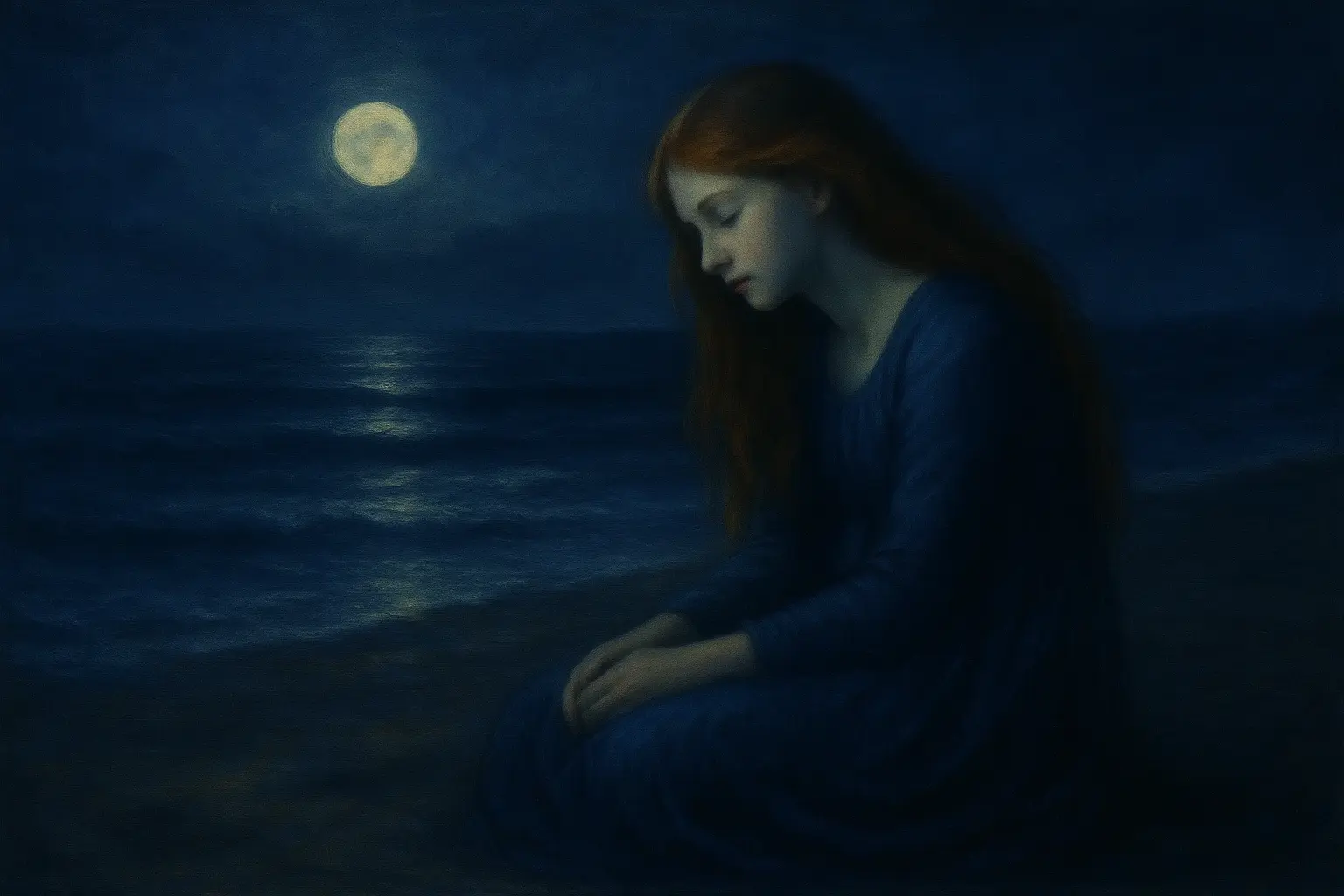
“Annabel Lee” is Edgar Allan Poe’s final complete poem, and it’s achingly beautiful in a way that’s different from his usual dark work. Published in 1849, just two days after Poe’s death, this poem tells the story of a love so powerful that not even death can destroy it. While Poe is famous for horror and the macabre, “Annabel Lee” shows his softer side, though it’s still tinged with the darkness and obsession that define his writing.
The poem describes the speaker’s love for Annabel Lee, a love that began when they were both children in a kingdom by the sea. When she dies, the speaker refuses to accept that their love has ended. He blames angels for her death out of jealousy and claims he still lies beside her tomb every night. It’s romantic and unsettling at the same time, which is classic Poe. Whether you’re reading it for its beautiful language or analyzing it for class, “Annabel Lee” offers layers of meaning about love, loss, and the refusal to let go.
Table of Contents:
Full Poem Text
Due to the length of this poem, we’ve placed the full text on a separate page of our site. This keeps the article readable while still giving you access to the complete work.
You can view the full poem here: Annabel Lee by Edgar Allan Poe
Summary and Meaning
The poem opens with the speaker telling us about Annabel Lee, a maiden who lived in a kingdom by the sea many years ago. The only thing she cared about was loving the speaker, and he loved her just as much. They were both young, maybe even children, but their love was more powerful than adult love. It was so intense and pure that even the angels in heaven noticed it.
Here’s where things get dark. The speaker claims that the angels became jealous of their love, so they sent a cold wind that killed Annabel Lee. Her wealthy relatives came and took her away, shutting her in a tomb by the sea. But the speaker insists their love is stronger than death. He says their souls are still bound together, and nothing can separate them.
Every night, the speaker goes to the tomb by the sea and lies down beside his dead love. He sees her in the stars, feels her in the moon, and dreams only of her. The poem ends with him still lying by her sepulchre, unable and unwilling to move on.
The deeper meaning? On one level, this is a beautiful tribute to eternal love. The speaker’s devotion survives death itself, which can seem romantic. But there’s also something obsessive and unhealthy about it. He’s literally lying in a tomb every night, clinging to the past, unable to live in the present. The poem explores how grief and love can become twisted together, how devotion can turn into an inability to let go. It’s about the fine line between beautiful remembrance and destructive obsession.
Themes and Analysis
Love Beyond Death
The central theme is that true love transcends mortality. The speaker insists repeatedly that death hasn’t ended his relationship with Annabel Lee. Their souls remain connected regardless of physical separation. This is romantic in the truest sense, suggesting that some bonds are so powerful they exist outside normal reality. But Poe complicates this romanticism by showing us how this belief affects the speaker’s life. He’s not moving forward or finding peace. He’s trapped in the past.
Jealousy and Blame
The speaker needs someone to blame for Annabel Lee’s death, so he blames the angels. He claims they were jealous of the pure love between two mortals and killed her out of spite. This externalization of blame is interesting psychologically. Rather than accepting that death is random or natural, he creates a narrative where cosmic forces conspired against them. This gives meaning to senseless loss but also feeds his obsession. If angels killed her out of jealousy, then his love really was extraordinary, worth clinging to forever.
Youth and Innocence
Poe emphasizes that the speaker and Annabel Lee were children when their love began. He mentions this multiple times: “I was a child and she was a child.” This youthful innocence makes their love seem purer and more idealized. But it also raises questions about the reliability of the speaker’s memories. Is he accurately remembering their relationship, or has he idealized a childhood romance into something it never was? The emphasis on youth also suggests a love frozen in time, never allowed to mature or change.
Isolation and the Sea
The kingdom by the sea creates a sense of isolation and timelessness. The sea appears throughout the poem as both setting and symbol. It’s beautiful but also cold and deadly (the wind came from the sea). The constant sound of waves mirrors the repetitive nature of the speaker’s grief. The sea is also liminal, a boundary between land and water, life and death, past and present. The speaker exists in this in-between space, unable to fully join either the living or the dead.
Obsession Disguised as Devotion
This might be the most important theme. The speaker presents his nightly visits to the tomb as proof of his undying love, but they also suggest an unhealthy inability to move forward. He’s literally lying down in a sepulchre every night. This goes beyond normal grieving into something more disturbing. Poe doesn’t judge this behavior explicitly, but the poem’s tone grows darker as it progresses. What starts as a sweet love story becomes increasingly unsettling.
Structure and Form
“Annabel Lee” consists of six stanzas of varying lengths, with the rhyme scheme shifting slightly throughout but maintaining consistency within stanzas. Poe uses a lot of internal rhyme and repetition to create a musical, almost hypnotic effect. The poem feels like a ballad or a fairy tale, which fits the “kingdom by the sea” setting.
The meter is primarily anapestic, with lines often having three or four beats. This creates a rolling, wave-like rhythm that mirrors the sea setting. The rhythm speeds up and slows down throughout the poem, sometimes feeling light and romantic, other times heavy and mournful. This variation reflects the speaker’s emotional state as he tells his story.
Repetition is key to how the poem works. Poe repeats “kingdom by the sea,” “Annabel Lee,” “loved with a love,” and other phrases throughout. This repetition serves multiple purposes. It makes the poem memorable and musical, but it also mimics obsessive thinking. The speaker can’t stop circling back to the same ideas, the same memories, the same name. The repetition traps us in his mental loop.
The poem’s language is relatively simple compared to some of Poe’s other work. He uses short words and straightforward sentences, which creates the feeling of a folk tale or children’s story. But this simplicity is deceptive. The childlike language reflects the speaker’s idealized memories while also making the darker elements more disturbing through contrast.
Poe also uses sound devices brilliantly. The frequent long “e” sounds (Lee, sea, me, we) create a keening, mournful quality. The alliteration and assonance throughout make the poem flow like music or like waves against shore. These technical choices aren’t just pretty; they reinforce the poem’s emotional impact.
Historical and Literary Context
“Annabel Lee” was published on October 9, 1849, in the New York Tribune, just two days after Edgar Allan Poe’s death at age 40. It’s believed to be the last complete poem he wrote, which adds poignancy to its themes of love and death. The poem appeared in two different publications shortly after his death, suggesting Poe had been circulating it before he died.
The most common interpretation is that Annabel Lee represents Poe’s wife Virginia Clemm, who died of tuberculosis in 1847 at age 24. Poe married Virginia when she was just 13 and he was 27, and they had been together since childhood (she was his cousin). The emphasis on childhood love in the poem seems to reference their relationship. Virginia’s death devastated Poe, and he struggled with grief, alcoholism, and erratic behavior in the two years between her death and his own.
However, Poe’s biographers note that he was also involved with several other women after Virginia’s death, including Sarah Helen Whitman and Annie Richmond. Some scholars think the poem might reference these relationships or might be a composite of all the women Poe loved. Poe himself encouraged this ambiguity by not explicitly connecting the poem to any real person.
“Annabel Lee” fits into the Romantic literary tradition with its emphasis on intense emotion, idealized love, and the supernatural. Romantic poets often wrote about love transcending death and about the power of memory and imagination. But Poe adds his characteristic darkness. Where other Romantic poets might end with hopeful reunion in an afterlife, Poe gives us a speaker lying in a tomb, unable to move forward.
The poem also connects to the Victorian fascination with death, mourning, and memento mori. Victorian culture had elaborate mourning rituals and romanticized death in ways that seem strange to modern readers. The speaker’s behavior, while extreme, would have resonated with readers familiar with extended mourning periods and visits to family tombs.
Significance and Impact
“Annabel Lee” has become one of the most beloved and frequently quoted poems in American literature. Its combination of beautiful language and accessible emotion makes it appealing to readers who might find Poe’s horror stories too dark. The poem proves Poe could write tenderness alongside terror, love alongside madness.
The poem has had enormous cultural impact. It’s been set to music by numerous composers, adapted into songs by musicians ranging from Joan Baez to Stevie Nicks, and referenced in countless books, films, and television shows. The phrase “kingdom by the sea” has entered popular consciousness as a way to describe an idealized past or lost love.
From a craft perspective, “Annabel Lee” demonstrates Poe’s mastery of sound and rhythm. It’s a poem that demands to be read aloud, and its musical quality has influenced generations of poets. The way Poe uses repetition to create both beauty and unease remains a lesson in how form can enhance content.
The poem remains relevant because it captures something universal about grief and love. Most people have experienced that feeling of wanting to hold onto someone or something lost, of feeling that death shouldn’t have the final say. The speaker’s refusal to let go resonates even if we recognize it’s unhealthy. We understand the impulse even if we wouldn’t act on it the same way.
Famous Lines and Quotes
“It was many and many a year ago, / In a kingdom by the sea.” This opening immediately establishes the fairy-tale quality of the poem. The repetition of “many” and the vague setting create a timeless, mythical atmosphere.
“But we loved with a love that was more than love.” This line captures the speaker’s insistence that his relationship with Annabel Lee was extraordinary, beyond normal human experience. The repetition of “love” emphasizes his point while also suggesting he can’t quite articulate what made it special.
“The angels, not half so happy in Heaven, / Went envying her and me.” The speaker’s explanation for Annabel Lee’s death is both poetic and psychologically revealing. He needs to believe their love was so powerful it threatened celestial beings.
“And neither the angels in Heaven above / Nor the demons down under the sea / Can ever dissever my soul from the soul / Of the beautiful Annabel Lee.” This stanza asserts the eternal nature of their bond. Nothing in heaven or hell can separate them, the speaker claims. It’s romantic but also suggests an obsession that might not be entirely healthy.
“And so, all the night-tide, I lie down by the side / Of my darling—my darling—my life and my bride, / In her sepulchre there by the sea.” The final image is both touching and disturbing. The repetition of “my darling” sounds like a lullaby, but the reality of lying in a tomb every night is unsettling.
Conclusion
“Annabel Lee” by Edgar Allan Poe is a poem that works on multiple levels. On the surface, it’s a beautiful tribute to eternal love, full of musical language and romantic imagery. The kingdom by the sea, the childhood sweethearts, the love that transcends death, these are the elements of timeless romance. But underneath that surface, Poe gives us something more complex and darker.
The speaker’s devotion to Annabel Lee has become an obsession that prevents him from living. He spends every night in a tomb, clinging to the past, unable to accept that she’s gone. Is this romantic or tragic? Poe leaves that question open. We can read the poem as a celebration of undying love or as a warning about how grief can consume us. Both interpretations are valid, and that ambiguity is part of what makes the poem so powerful.
What’s certain is that “Annabel Lee” captures something true about love and loss. The way the speaker can’t stop repeating her name, the way he sees her everywhere, the way he needs to believe their love was special enough to threaten angels, these are recognizable patterns of grief. Poe understands that losing someone you love can feel like a wound that never heals, and sometimes we’d rather live with the pain than let go of the person who caused it.
Frequently Asked Questions
Who was Annabel Lee in real life?
Most scholars believe Annabel Lee represents Poe’s wife Virginia Clemm, who died in 1847. They married when she was 13 and he was 27, and her death from tuberculosis devastated him. However, Poe never confirmed this connection, and some biographers think the poem might reference other women he loved, including Sarah Helen Whitman or Annie Richmond. It’s also possible Annabel Lee is a composite or purely fictional. Poe deliberately kept this ambiguous.
When was Annabel Lee written?
The exact date of composition is unknown, but “Annabel Lee” was published in October 1849, two days after Poe’s death. It’s believed to be the last complete poem he wrote. Given that it was published so soon after his death and appeared in multiple publications, Poe likely wrote it in the months before he died and had been sharing it with friends and editors.
What killed Annabel Lee in the poem?
The poem says a wind came “out of the cloud by night, chilling and killing my Annabel Lee.” The speaker blames jealous angels for sending this wind. In reality, if the poem is about Virginia, she died of tuberculosis. The “chilling” wind could be a poetic representation of the cold and wasting nature of that disease. The vague cause of death also keeps the poem in fairy-tale territory rather than harsh medical reality.
What does the kingdom by the sea represent?
The kingdom by the sea is both a literal setting and a symbol. Literally, it creates a fairy-tale atmosphere, removed from ordinary time and place. Symbolically, it represents an idealized past, perhaps childhood or a time of innocence. The sea itself symbolizes the boundary between life and death, the known and unknown. The kingdom being “by” the sea suggests it exists at the edge of reality, in a liminal space between memory and imagination.
Is Annabel Lee a true story?
While the poem likely draws on Poe’s real experiences with loss (especially Virginia’s death), it’s not a factual account. Poe uses poetic license throughout, creating a stylized, mythical version of events rather than a realistic narrative. The speaker’s claim to lie in the tomb every night, the jealous angels, the kingdom by the sea, these are poetic inventions. The emotions are probably real, but the story is literature, not autobiography.
What is the tone of Annabel Lee?
The tone is complex and shifts throughout the poem. It begins nostalgic and romantic, almost like a fairy tale. As the poem progresses, it becomes mournful and melancholy. By the end, there’s something darker and more obsessive in the tone. The speaker’s insistence on his nightly vigil at the tomb adds an unsettling quality. Overall, the tone blends sweetness with sorrow, devotion with obsession, creating an emotional complexity that’s characteristic of Poe’s best work.
Why does the speaker blame angels for Annabel Lee’s death?
Blaming the angels serves several psychological purposes for the speaker. First, it provides an explanation for senseless loss. Instead of random bad luck or disease, there’s a reason: jealousy. Second, it validates the specialness of their love. If angels were jealous enough to kill her, their love must have been extraordinary. Third, it externalizes his anger and grief. He can be angry at cosmic forces rather than at Annabel Lee for dying or at himself for being unable to save her. The angels become a target for emotions he can’t otherwise process.
Explore More Poe
If you enjoyed our analysis, keep exploring Poe’s universe with the following articles:
The Raven by Edgar Allan Poe: Analysis and Interpretation
A Dream Within a Dream by Edgar Allan Poe: Analysis and Interpretation