
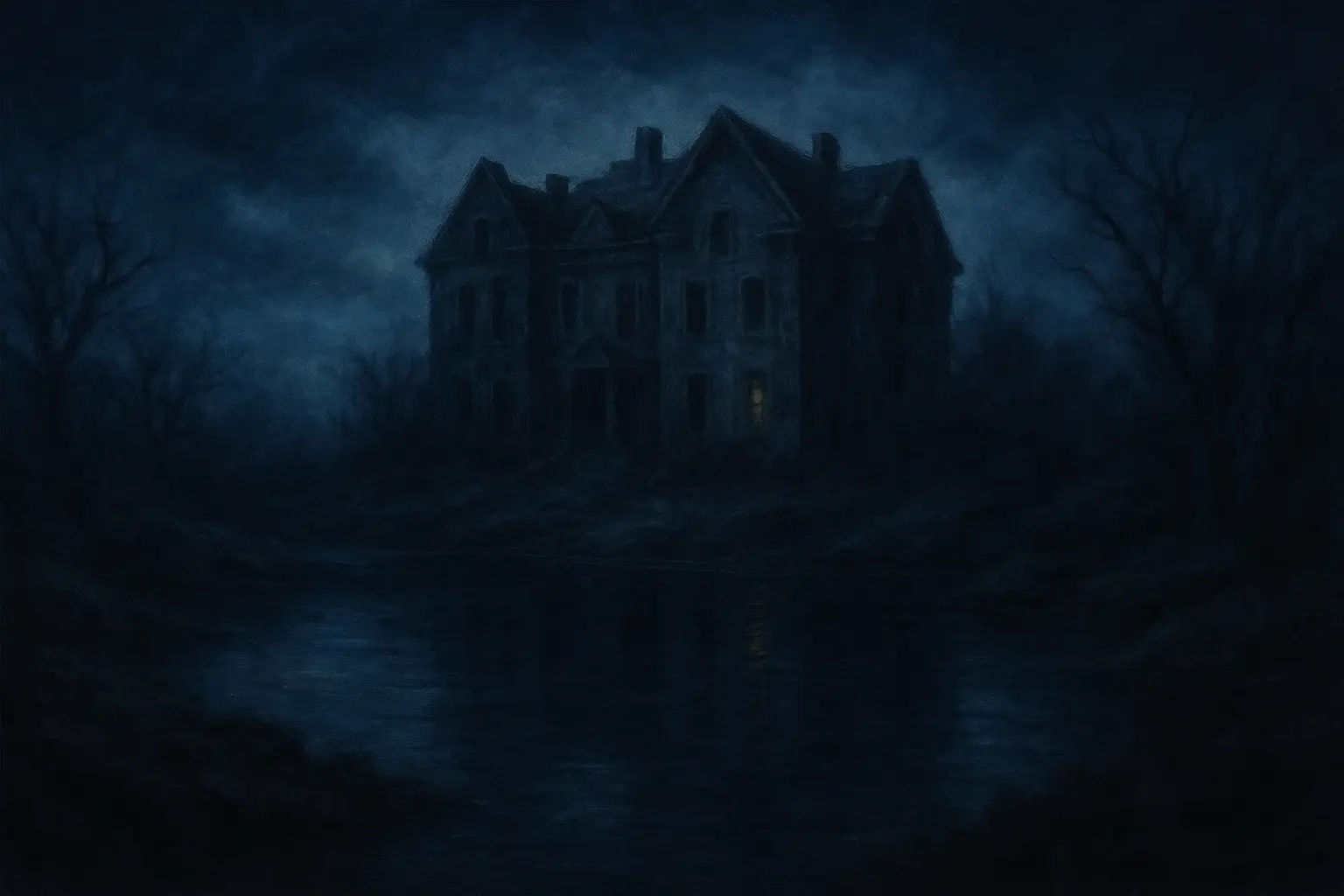
“The Fall of the House of Usher” is one of Edgar Allan Poe’s most chilling and atmospheric short stories, and it’s a masterpiece of Gothic horror. Published in 1839, this tale follows an unnamed narrator who visits his childhood friend Roderick Usher at his decaying family mansion. What starts as a visit to comfort a sick friend quickly turns into a nightmare of madness, death, and supernatural terror.
What makes this story so effective is how Poe blurs the line between the psychological and the supernatural. Is the house actually cursed, or is Roderick losing his mind? Are the strange events real, or are they manifestations of fear and guilt? Poe never gives us easy answers, and that ambiguity is what makes the story so unsettling. The house itself becomes a character, mirroring the mental and physical decay of the Usher family. Whether you’re reading it for a literature class or just love a good ghost story, “The Fall of the House of Usher” delivers layers of meaning wrapped in an atmosphere of pure dread.
Table of Contents:
Full Story Text
Due to the length of this story, we’ve placed the full text on a separate page of our site. This keeps the article readable while still giving you access to the complete work.
You can view the full story here: The Fall of the House of Usher by Edgar Allan Poe
Summary and Meaning
The story opens with the narrator arriving at the House of Usher on a dreary autumn day. Right away, the place feels wrong. The mansion looks ancient and decayed, with a barely visible crack running down the front. The narrator has come because his old friend Roderick Usher sent him a letter begging for company, saying he’s suffering from a mysterious illness.
When they meet, the narrator is shocked by how much Roderick has changed. He’s pale, nervous, and hypersensitive to light, sound, and touch. Roderick explains that his twin sister Madeline is also ill with a strange disease that’s slowly paralyzing her. The narrator tries to cheer up his friend by reading to him and listening to his impromptu musical compositions, but nothing really helps. Then Madeline dies, or so it seems.
Roderick insists on temporarily placing her body in a vault beneath the house rather than burying her immediately. The narrator helps him, and he notices that Madeline has a slight blush on her face and a faint smile, which is weird for a corpse. After this, Roderick becomes even more agitated and strange. He starts hearing sounds and becomes convinced something terrible is about to happen.
During a storm about a week later, Roderick appears at the narrator’s door in a state of complete panic. To calm him down, the narrator reads from a romance called “Mad Trist.” But as he reads descriptions of sounds (a door breaking, a shriek, a shield clattering), they hear the exact same sounds coming from somewhere in the house. Roderick finally confesses that he’s been hearing these sounds for days and that they buried Madeline alive. At that moment, the door bursts open and Madeline stands there, bloody and terrifying. She falls on Roderick, and both twins die together.
The narrator runs from the house in terror, and as he looks back, he sees the crack in the mansion widen until the entire House of Usher collapses into the dark lake surrounding it.
The deeper meaning? The story is about the decay and fall of an entire family line. The Ushers have interbred for generations, keeping their bloodline “pure,” which has led to physical and mental deterioration. Roderick and Madeline are the last of their line, and when they die, so does the house itself. It’s also about guilt, madness, and how fear can become a self-fulfilling prophecy. Roderick’s terror that something awful will happen actually causes it to happen.
Themes and Analysis
Decay and Deterioration
Everything in “The Fall of the House of Usher” is falling apart. The house is crumbling, with fungi growing on its walls and a crack threatening to split it in two. Roderick and Madeline are both wasting away from mysterious illnesses. Even the landscape around the house feels dead and lifeless. Poe creates this overwhelming atmosphere of things ending, of a family and a way of life that has reached its final moments. The physical decay mirrors moral and genetic decay from generations of the Ushers marrying within their own family.
The Connection Between Mind and Environment
One of the most fascinating aspects of this story is how Poe suggests that the house and Roderick are somehow linked. The narrator notices that the mansion seems to have “an atmosphere peculiar to themselves,” as if the house has its own consciousness. As Roderick’s mental state deteriorates, the house seems to respond. Is the house making Roderick sick, or is his illness affecting the house? Poe leaves this deliberately unclear, creating this unsettling sense that environment and psychology are inseparable.
Isolation and Its Consequences
The Usher family has isolated itself for generations, both genetically and socially. They’ve stayed in their ancestral home, marrying relatives, cutting themselves off from the outside world. This isolation has destroyed them. Roderick is so sensitive to stimuli that normal life is impossible for him. He’s trapped in his house, trapped in his family history, trapped in his own nervous system. The story suggests that this kind of isolation and inbreeding, whether literal or metaphorical, leads nowhere good.
Repression and the Return of the Repressed
This is the big psychological theme. Roderick buries Madeline alive, probably knowing on some level that she isn’t really dead. He tries to repress this knowledge, to keep it locked away in the vault of his mind (and the vault beneath the house). But repressed things don’t stay buried. They come back, often in more terrifying forms. Madeline’s return from the tomb represents all the guilt, fear, and terrible secrets the Usher family has tried to hide finally breaking free and destroying everything.
Doubling and Duality
Roderick and Madeline are twins, and Poe hints that they might share some kind of supernatural connection. They seem to be two halves of the same person. When one suffers, so does the other. When Madeline dies (or seems to), Roderick doesn’t get better; he gets worse, as if part of him has died too. Their final embrace in death suggests they were never meant to exist separately. The house itself doubles this theme, as it’s both literally cracking in half and serving as a physical representation of the family’s split psyche.
Structure and Form
Poe structures this story brilliantly to maximize dread and inevitability. The narrative follows a straightforward chronological path, but the pacing is what makes it work. The story moves slowly at first, spending considerable time on atmosphere and description. Poe wants us to really feel the oppressive weight of the house and Roderick’s deteriorating mental state before anything overtly scary happens.
The narrator serves as our guide and our anchor to sanity. He’s rational, skeptical, and tries to find logical explanations for everything. By filtering the story through his perspective, Poe makes the supernatural elements more unsettling because we experience his growing doubt about what’s real. The narrator starts confident and ends up fleeing in terror, and we take that journey with him.
Poe uses a frame narrative technique, starting and ending with the narrator’s approach to and escape from the house. This creates a sense of complete experience, of a nightmare that has definite boundaries. We enter the story with the narrator and leave with him, which provides a strange kind of relief even as the house collapses.
The story’s climax is masterfully constructed. Poe creates this parallel between the romance the narrator is reading and the actual events happening in the house. As the fictional knight in “Mad Trist” breaks down a door, they hear a real door breaking. This blurring of fiction and reality adds another layer of unreality and suggests that Roderick’s artistic visions and reality have merged completely.
Historical and Literary Context
Edgar Allan Poe wrote “The Fall of the House of Usher” in 1839, and it was published in Burton’s Gentleman’s Magazine. At this point in his career, Poe was developing the psychological horror story into an art form. While Gothic literature had existed for decades, usually set in European castles and featuring aristocratic villains, Poe was creating something uniquely American and deeply psychological.
The story reflects anxieties about heredity and degeneration that were common in the 19th century. People were fascinated and horrified by the idea that family traits (both physical and mental) could deteriorate over generations. The Ushers represent the dark side of aristocratic families who kept their bloodlines “pure” through intermarriage. This practice often led to genetic problems, though people in Poe’s time didn’t understand genetics the way we do now.
Gothic literature traditionally deals with old families, crumbling buildings, madness, and the supernatural. “The Fall of the House of Usher” by Edgar Allan Poe hits all these notes but adds Poe’s particular psychological intensity. He’s not just interested in scaring readers with ghosts; he’s exploring how fear, guilt, and madness work in the human mind.
The story also reflects Romantic ideas about the connection between humans and their environment, the power of the imagination, and the thin line between genius and madness. Roderick is presented as an artist and intellectual, but his sensitivity and creativity have become pathological. This reflects Romantic anxieties about the cost of artistic genius.
Poe’s own life influences the story in subtle ways. He dealt with illness, poverty, and the deaths of several women close to him. The theme of watching a beloved woman waste away from illness probably resonated with his personal experiences. His wife Virginia was already showing signs of tuberculosis around this time, though she wouldn’t die until 1847.
Significance and Impact
This story essentially defined what American Gothic horror could be. Before Poe, most Gothic tales were set in Europe and relied heavily on external threats like vampires or villains. Poe turned the horror inward, making it psychological and atmospheric. “The Fall of the House of Usher” showed that the scariest monsters are often inside our own minds.
The story has influenced countless writers, filmmakers, and artists. You can see its impact in everything from H.P. Lovecraft’s cosmic horror to modern haunted house stories. The idea of a house that’s somehow alive or connected to its inhabitants has become a staple of horror fiction. Films like “The Haunting,” “The Shining,” and countless others owe a debt to Poe’s vision.
From a literary technique standpoint, the story is a masterclass in atmosphere and ambiguity. Poe proves you don’t need to explain everything to create effective horror. In fact, leaving things unexplained often makes them scarier. Modern horror writers still study how Poe creates dread through description, pacing, and psychological insight.
For students and literature lovers, “The Fall of the House of Usher” remains important because it works on so many levels. You can analyze it as a supernatural tale, a psychological study, a commentary on aristocratic decay, or a metaphor for artistic sensitivity. It’s rich enough to support multiple interpretations while still being a gripping, scary story.
Famous Lines and Quotes
“During the whole of a dull, dark, and soundless day in the autumn of the year, when the clouds hung oppressively low in the heavens, I had been passing alone, on horseback, through a singularly dreary tract of country.” This opening sentence immediately establishes the oppressive atmosphere that will dominate the entire story. Poe’s use of alliteration and heavy, dark words makes you feel the weight of the scene.
“I looked upon the scene before me—upon the mere house, and the simple landscape features of the domain—upon the bleak walls—upon the vacant eye-like windows—upon a few rank sedges—and upon a few white trunks of decayed trees—with an utter depression of soul.” The narrator’s first view of the house tells us everything we need to know about what’s coming. Those “eye-like windows” suggest the house is watching, aware.
“There was an iciness, a sinking, a sickening of the heart—an unredeemed dreariness of thought which no goading of the imagination could torture into aught of the sublime.” This captures that specific kind of dread that has no romantic or exciting element to it, just pure hopeless gloom.
“We have put her living in the tomb!” Roderick’s confession is the horror at the heart of the story. The guilt and terror in this line drive the final catastrophe.
Conclusion
“The Fall of the House of Usher” by Edgar Allan Poe endures because it taps into deep fears about family, madness, and the secrets we bury. Poe wasn’t just writing a ghost story; he was exploring how guilt and fear can literally tear apart people and the places they inhabit. The story works as supernatural horror and as psychological drama, and that dual nature is what makes it so powerful.
What makes it especially effective is Poe’s refusal to give us easy answers. Is the house really cursed, or is everything a product of Roderick’s diseased imagination? Was Madeline actually alive in the tomb, or did she rise from the dead? Poe leaves these questions open, trusting readers to be more disturbed by ambiguity than by certainty.
The story’s ending, with the complete destruction of both the family and the house, feels inevitable by the time we reach it. Everything in the story has been moving toward this collapse from the very first sentence. That sense of doom, of watching something fall apart that cannot be saved, is what makes “The Fall of the House of Usher” such a memorable and unsettling reading experience.
Frequently Asked Questions
What does the House of Usher symbolize?
The house works as a symbol on multiple levels. Most obviously, it represents the Usher family itself, with its decay mirroring the family’s physical and mental deterioration. The crack running down the house suggests the split or fracture within the family and within Roderick’s mind. The house also symbolizes the past and tradition, things that can trap and suffocate the present. Some readers interpret it as a symbol of the human mind, with its buried vault representing the unconscious where we hide terrible secrets.
What illness do Roderick and Madeline Usher have?
Poe never gives a specific medical diagnosis, and that’s intentional. Roderick suffers from extreme sensory sensitivity and what we might today call severe anxiety or panic disorder. Madeline has a “cataleptical” illness that involves seizures and paralysis. Many scholars believe their conditions result from generations of inbreeding in the Usher family. The vagueness of their illnesses makes them more disturbing and suggests that their problems are both physical and spiritual, a kind of family curse.
Did Roderick know Madeline was alive when he buried her?
This is one of the story’s great ambiguities. The evidence suggests he at least suspected. He insists on keeping her in the vault beneath the house rather than burying her properly, and he becomes increasingly agitated after her “death.” His final confession, “We have put her living in the tomb!” could mean he knew all along or that he’s just realized it. Either way, his guilt suggests he had doubts that he tried to suppress.
What is the significance of Roderick and Madeline being twins?
The twin connection emphasizes how intertwined and inseparable they are. In Poe’s time, twins were sometimes thought to share a mystical bond. Roderick and Madeline seem to represent two halves of the same person or two aspects of the same damaged psyche. Their twinship also highlights the incestuous nature of the Usher family tree, as they’re the products of generations of inbreeding. When one twin dies, the other cannot survive, suggesting they were never meant to exist as separate beings.
What happens at the end of The Fall of the House of Usher?
In the climactic ending, Madeline (who was buried alive) breaks out of her tomb and appears at the door. She falls upon her brother Roderick, and they both die together. The narrator flees the house, and as he looks back, he sees the crack in the mansion widen until the entire structure collapses into the dark lake surrounding it. The house and the family are destroyed simultaneously, suggesting they were always one and the same.
What is the narrator’s role in the story?
The narrator serves as our eyes and ears, a rational outsider who helps us process the strange events at the House of Usher. He’s Roderick’s childhood friend but hasn’t seen him in years, which gives him some distance and objectivity. As the story progresses, even his rational explanations begin to fail, and his growing fear mirrors our own. By the end, his flight from the house confirms that something truly terrible and inexplicable has occurred.
Is The Fall of the House of Usher supernatural or psychological?
This ambiguity is central to the story’s power. Poe deliberately leaves it unclear whether the events are supernatural (the house is actually cursed, Madeline rises from the dead) or psychological (everything is a product of Roderick’s madness and guilt). The story works both ways. You can read it as a ghost story or as a psychological breakdown, and either interpretation is valid. This dual possibility makes the story richer and more disturbing than if Poe had committed to just one explanation.
Explore More Poe
If you enjoyed our analysis, keep exploring Poe’s universe with the following articles:
The Black Cat by Edgar Allan Poe: Analysis and Interpretation
The Cask of Amontillado by Edgar Allan Poe: Analysis and Interpretation
The City in the Sea by Edgar Allan Poe: Analysis and Interpretation