
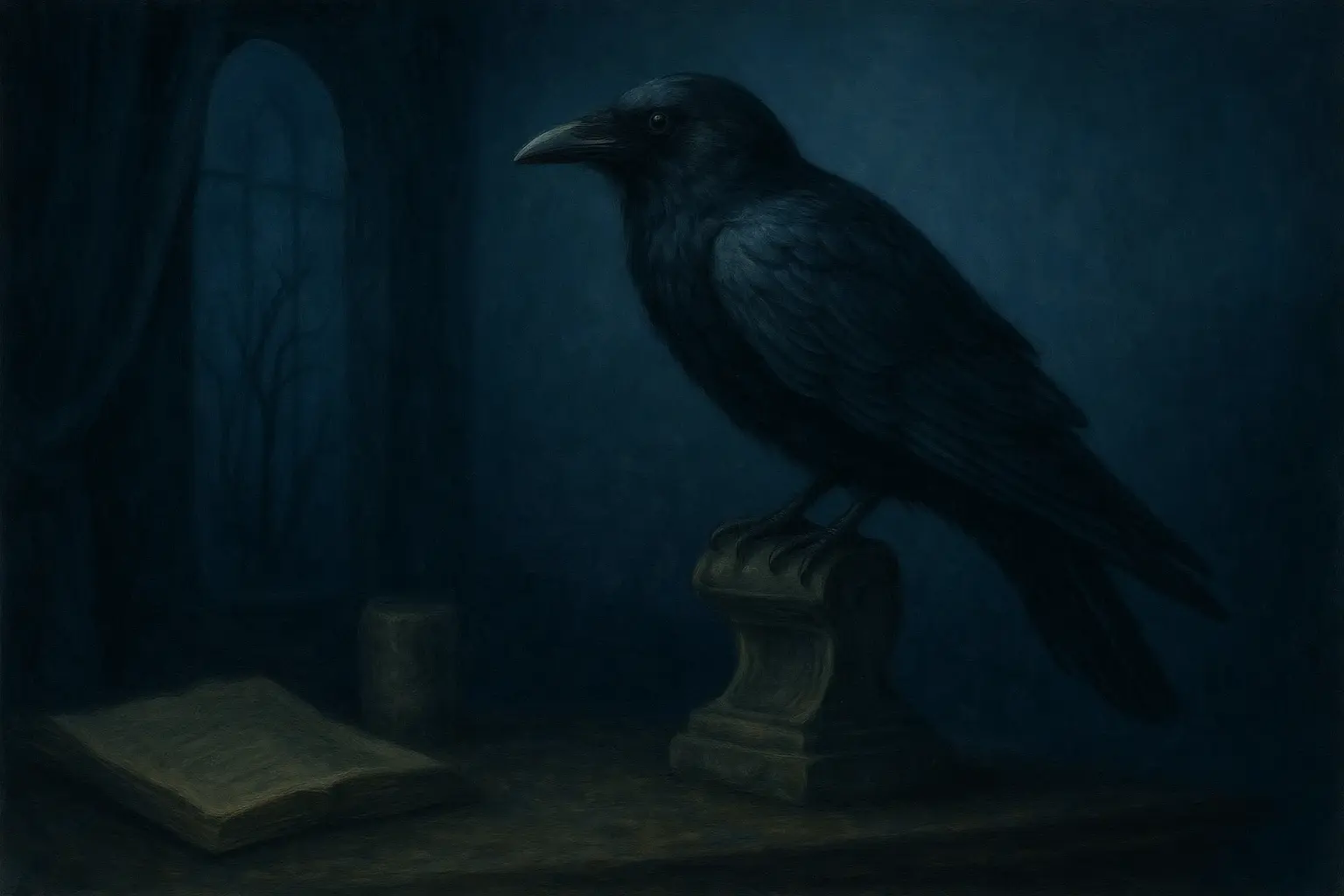
“The Raven” stands as one of the most recognizable poems in American literature, and honestly, once you’ve read it, that haunting “Nevermore” sticks with you forever. Published in 1845, Edgar Allan Poe’s masterpiece tells the story of a grieving man visited by a mysterious raven on a dark December night. What makes this poem so powerful isn’t just its spooky atmosphere (though Poe absolutely nails that) but the way it captures the raw, almost unbearable nature of grief and loss.
The poem’s genius lies in how Poe uses a simple bird to represent something much darker: the narrator’s own spiraling despair. Through 18 stanzas of hypnotic rhythm and rhyme, we watch someone slowly lose their grip on hope, asking questions they know will only bring pain. It’s psychological horror at its finest, and it made Poe famous practically overnight. Whether you’re reading it for a class or just because you love good poetry, “The Raven” by Edgar Allan Poe rewards close attention with layers of meaning that go far beyond a talking bird.
Table of Contents:
Full Poem Text
Due to the length of this poem, we’ve placed the full text on a separate page of our site. This keeps the article readable while still giving you access to the complete work.
You can view the full poem here: The Raven by Edgar Allan Poe
Summary and Meaning
The poem opens with our narrator, exhausted and sad, reading old books late one December night, trying to forget about Lenore, the woman he loved who has died. When he hears tapping at his door, he finds nothing there, just darkness. The tapping continues at his window, and when he opens it, a raven flies in and perches on a bust of Pallas Athena above his door.
At first, the narrator treats this like a weird but harmless visit. He asks the bird its name, and it responds with its only word: “Nevermore.” Initially amused, the narrator starts asking the raven questions, beginning with casual ones but gradually moving toward the questions that really torture him. Will he find relief from his sorrow? Will he ever be reunited with Lenore in heaven? To everything, the raven answers “Nevermore.”
Here’s where the poem gets really interesting. The narrator isn’t stupid. He knows the bird is just repeating the one word it knows. But he can’t stop himself from asking questions and treating each “Nevermore” as a prophecy of doom. By the end, he’s completely unraveled, ordering the bird to leave, but it won’t budge. The raven sits there still, casting its shadow over him, and that shadow, Poe tells us, will never lift.
The deeper meaning? The raven represents the narrator’s grief and depression, which he can’t escape no matter how much he wants to. He’s trapped in his own mind, asking questions designed to hurt himself, unable to move forward from loss. The bird isn’t really the problem. The narrator’s relationship with his own pain is.
Themes and Analysis
Grief and Loss
The most obvious theme in “The Raven” by Edgar Allan Poe is how grief can consume a person entirely. The narrator has lost Lenore, and instead of processing this loss healthily, he’s torturing himself with it. Notice how he’s surrounded by books but can’t focus, how he’s seeking “surcease of sorrow” (basically, any escape from feeling what he’s feeling). Poe shows us that sometimes people become attached to their grief, almost comfortable with it, even as it destroys them. The narrator could close the window or ignore the bird, but he doesn’t. He needs the pain somehow.
The Permanence of Death
That word “Nevermore” hammers home one brutal truth: death is final. The narrator keeps hoping for some loophole, some reassurance that he’ll see Lenore again, but the universe (via one stubborn bird) keeps reminding him that what’s gone is gone. It’s a hard theme, but Poe doesn’t sugarcoat it. The poem forces readers to confront mortality head-on. Each time the narrator asks if there’s relief or reunion waiting for him, that single word destroys his hope a little more.
Madness and Obsession
Watch how the narrator’s mental state deteriorates throughout the poem. He starts rational, even a bit amused, but ends up screaming at a bird. This descent into madness happens because he can’t let go of Lenore, of hope, of the need for answers. The chamber itself feels like it’s closing in, stuffy with memories and shadows. Poe brilliantly captures how obsessive thoughts can trap someone in a cycle of despair. The narrator’s intelligence actually works against him here. He’s self-aware enough to know the bird is meaningless, yet he can’t stop giving it power over him.
Memory and Torment
The physical setting of “The Raven” is saturated with memory. The bust of Pallas, the purple curtains, the lamp light, all these details create an atmosphere where the past feels more real than the present. The narrator sits surrounded by books, presumably trying to escape into knowledge or stories, but Lenore’s memory invades everything. Poe understood that grief isn’t just sadness, it’s the way lost loved ones haunt our familiar spaces and possessions.
Structure and Form
Edgar Allan Poe wasn’t just throwing words together randomly. “The Raven” is a masterclass in poetic technique, and understanding its structure helps you appreciate why it’s so memorable and effective.
The poem consists of 18 stanzas, each containing six lines. Poe uses trochaic octameter, which means each line has eight trochaic feet (a stressed syllable followed by an unstressed one). This creates that distinctive “DA-dum DA-dum DA-dum” rhythm that makes the poem feel like a heartbeat or a ticking clock. It’s hypnotic and a bit unsettling, which perfectly matches the content.
The rhyme scheme is ABCBBB, which is unusual and clever. Most of each stanza follows a predictable pattern, but then those three B rhymes at the end create this hammering effect, especially since the final line of every stanza ends with an “or” sound (Lenore, door, Nevermore, evermore, etc.). This repetition builds throughout the poem until you can almost predict what’s coming, yet it still hits hard every time.
Poe also uses internal rhyme within lines, not just at the end. Look at the opening: “Once upon a midnight dreary, while I pondered, weak and weary.” You’ve got “dreary/weary” rhyming in the same line. This makes the poem feel even more dense and intentional, like every single word is exactly where it needs to be.
The length of each stanza (six lines) gives Poe room to build tension and then release it with that final “Nevermore.” It’s long enough to develop a thought but short enough to keep the pace moving. If you read it out loud, you’ll notice how the rhythm almost forces you to speed up toward the end of each stanza, creating urgency and anxiety.
Historical and Literary Context
Poe wrote “The Raven” during a particularly tough period in his life. It was 1845, and while the poem would make him famous, he was struggling financially and dealing with his young wife Virginia’s illness (she had tuberculosis and would die two years later). You can feel some of that real anguish bleeding into the narrator’s voice. The poem was published in the New York Evening Mirror and became an instant sensation. People memorized it, recited it at parties, and Poe became a literary celebrity, though unfortunately, that didn’t translate into much money for him due to copyright laws of the time.
Literarily, “The Raven” fits perfectly into the Gothic tradition and Romanticism. Gothic literature loves dark settings, psychological horror, and the supernatural, all of which Poe delivers here. The Romantic movement emphasized emotion, nature, and the individual’s inner experience, often exploring darker feelings that earlier periods might have avoided. Poe took these elements and created something distinctly American, moving away from European Gothic castles to create horror in an ordinary chamber.
The poem also showcases Poe’s technical mastery. He wrote an essay called “The Philosophy of Composition” where he claimed to have calculated every element of “The Raven” mathematically for maximum effect. While he might have exaggerated how systematic his process was, the poem’s intricate rhyme scheme and its trochaic octameter rhythm create an almost hypnotic effect. Poe understood that form and content should work together, and “The Raven” by Edgar Allan Poe proves he knew exactly what he was doing.
Significance and Impact
“The Raven” didn’t just make Edgar Allan Poe famous. It fundamentally changed American poetry and popular culture. Before this poem, American literature was often seen as less sophisticated than European works. Poe created something that was undeniably American yet could stand alongside any European poem in terms of craft and emotional power.
The poem’s influence on popular culture has been massive. It’s been referenced in everything from “The Simpsons” to NFL team names (hello, Baltimore Ravens). Musicians, filmmakers, and other writers have borrowed from it constantly. The phrase “Quoth the Raven, Nevermore” has entered the language as a cultural shorthand for doom and finality.
From a literary standpoint, “The Raven” showed that poetry could be both technically brilliant and emotionally devastating. It proved that American writers could craft works with the complexity and depth of European literature while still creating something distinctly their own. The poem influenced countless writers after Poe, particularly in horror and dark fantasy genres.
For students and poetry lovers, “The Raven” remains important because it’s so teachable. You can analyze it from dozens of angles: psychological, formal, historical, symbolic. It rewards close reading while remaining accessible enough that anyone can grasp its emotional core on first encounter. That combination of depth and accessibility is rare and valuable.
Famous Lines and Quotes
“Once upon a midnight dreary, while I pondered, weak and weary.” This opening line immediately sets the mood and has become one of the most quoted beginnings in poetry. It’s got rhythm, atmosphere, and tells you everything about the narrator’s state of mind.
“Quoth the Raven ‘Nevermore.'” Obviously, this is THE line. It appears repeatedly throughout the poem, and its simplicity makes it devastating. Each repetition hits differently as the narrator’s questions grow more desperate.
“Deep into that darkness peering, long I stood there wondering, fearing, / Doubting, dreaming dreams no mortal ever dared to dream before.” This captures that moment of standing at the edge of the unknown, both literally and psychologically. Beautiful and unsettling.
“And my soul from out that shadow that lies floating on the floor / Shall be lifted—nevermore!” The final lines seal the narrator’s fate. That shadow represents his grief and despair, and Poe makes clear there’s no escape coming. It’s a gut-punch ending that stays with readers.
Conclusion
“The Raven” by Edgar Allan Poe endures because it taps into something universal: the experience of loss and the sometimes self-destructive ways we deal with it. Poe wasn’t just writing a spooky poem about a bird. He was exploring the darkest corners of human psychology with incredible insight. The poem works on multiple levels: as entertainment, as technical achievement, and as genuine emotional expression.
What makes it especially powerful is how it refuses to offer comfort. There’s no redemption arc here, no moment where the narrator finds peace. Sometimes grief wins, and sometimes we become our own worst enemies in dealing with pain. That honesty, combined with Poe’s masterful language and rhythm, is why English teachers still assign this poem and why readers still connect with it.
Whether the raven represents death, grief, the narrator’s own dark thoughts, or just a bird that learned one word, well, that’s part of the beauty. “The Raven” leaves room for interpretation while hitting emotional notes that everyone can understand. It’s a poem that respects its readers’ intelligence while absolutely wrecking them emotionally.
Frequently Asked Questions
What does the raven symbolize in the poem?
The raven works as a symbol on multiple levels. Most directly, it represents the narrator’s grief and the finality of death. Some readers see it as a manifestation of his own dark thoughts. Notice how it tells him exactly what he fears most. Others interpret it as death itself, or fate, or the universe’s indifference to human suffering. Poe probably intended all these meanings to coexist.
Why does the raven only say “Nevermore”?
Practically speaking, Poe needed a word that could answer the narrator’s increasingly desperate questions in a way that maximized despair. “Nevermore” perfectly fits because it denies hope for the future. Within the poem’s logic, the raven is just a bird that learned one word from a previous owner. The narrator gives that word meaning by asking questions where “Nevermore” is the worst possible answer.
Is the raven real or imaginary?
Poe leaves this deliberately ambiguous. The bird seems physically real. It flies in, perches, and stays. But its timing and behavior are almost too perfect, showing up exactly when the narrator is most vulnerable. It could be a real bird that the narrator projects meaning onto, or a hallucination born from grief and exhaustion. Either reading works, which is part of the poem’s genius.
Why did Edgar Allan Poe choose a raven instead of another bird?
Poe actually explained this in his essay “The Philosophy of Composition.” He wanted a creature capable of speech, which led him to consider a parrot first. But parrots are too colorful and cheerful for the dark mood he was creating. Ravens are black, associated with death and ill omens in many cultures, and can indeed mimic human speech. The raven was simply the perfect choice for creating the atmosphere of dread and finality that the poem needed.
What is the setting of The Raven?
The poem takes place in the narrator’s chamber (bedroom or study) on a cold December night at midnight. The room is filled with books, has purple curtains, and contains a bust of Pallas Athena. These details matter because they create a claustrophobic, memory-filled space where the narrator is trapped with his grief. The December setting adds to the gloom and suggests the coldness of death and the end of things.
When was The Raven by Edgar Allan Poe published?
“The Raven” was first published on January 29, 1845, in the New York Evening Mirror. It was an immediate success and was quickly reprinted in other publications. This poem made Poe a household name almost overnight, though sadly the fame didn’t bring him the financial security he desperately needed.
Who is Lenore in the poem?
Lenore is the woman the narrator loved who has died. Poe doesn’t give us many details about her, and that’s intentional. She represents idealized lost love, the kind that becomes even more perfect in memory after death. Some scholars have connected Lenore to Poe’s own experiences with loss, particularly his mother and later his wife Virginia, though the poem was written before Virginia’s death.
Explore More Poe
If you enjoyed our analysis, keep exploring Poe’s universe with the following articles:
Annabel Lee by Edgar Allan Poe: Analysis and Interpretation
The Fall of the House of Usher by Edgar Allan Poe: Analysis and Interpretation